
29 Best Palworld Breeding Combos for Base, Mounts, and World Tree (1.0)
Choose from 29 current Palworld 1.0 breeding combos for useful base Pals, mounts, passive hunting, and World Tree progression.

The best Palworld breeding combo is the one that solves your next problem with parents you already own. Start with Beegarde if honey is blocking Cake, Anubis if crafting or mining is slow, Yakumo if you want better passive candidates, or one of the late-progression targets if your base is already stable.
This guide gives you 29 parent pairs for 11 useful targets in Palworld 1.0. Every pair returns the stated child in PalBreed's active breeding dataset. That means the recipes are dataset-confirmed, not individually hatched in-game.
“Best” here does not mean a universal combat tier. A target earns a place by solving a distinct utility or progression need, appearing in a current 1.0 recommendation source, and having at least one pair that survives a fresh dataset check.
Choose your best Pal breeding target first
| Your current goal | Breed this Pal | Why it belongs on the shortlist |
|---|---|---|
| Keep the Cake supply moving | Beegarde | Honey supports every later breeding batch |
| Speed up crafting and mining | Anubis | One target covers two common base bottlenecks |
| Prepare useful passives for future captures | Yakumo | Its partner skill helps seed traits onto wild encounter candidates |
| Cook Cake and food faster | Suzaku | It is the dedicated Kindling choice in the utility shortlist |
| Add focused Watering | Azurobe | It handles farms and mills when Watering is the slow station |
| Reduce Ice damage and avoid Frozen | Kitsun | Its reworked 1.0 partner skill now serves an ice-specific role |
| Cut ground-travel time | Palumba | It turns a breeding project into a faster route across the map |
| Protect a late-game party from explosions | Aegidron | Its party skill reduces explosive damage and prevents Stun |
| Build around a Dragon or Dark flying mount | Eidrolon | Its Attack and Movement Speed scale with those party types |
| Use a mounted Dark laser | Dualith Noct | Its one non-self route leads to a mount with an active Dark attack |
| Trade an active Pal's health for more Attack | Celesdir Noct | Its risky party effect suits a deliberate damage-focused setup |
If two rows sound useful, fix production before convenience. A faster mount does not help a Breeding Farm that is waiting for honey, and faster cooking does not fix a farm that has no ingredients.
21 utility breeding combos checked for Palworld 1.0
These seven utility targets come from Mobalytics' current 1.0 shortlist. PalBreed then checked each pair below against its active dataset. The rows are examples, not an ease ranking.
| Target | Dataset-confirmed parent pairs |
|---|---|
| Beegarde | Polapup + Jolthog; Penking + Cinnamoth; Nox + Hoodle |
| Anubis | Blazamut + Dualith; Bushi Noct + Orserk; Dualith Noct + Whalaska |
| Yakumo | Leafan + Lamball; Leafan + Vixy; Pupperai + Bakemi |
| Suzaku | Bushi + Bushi Noct; Bakemi + Frostplume; Grizzbolt + Solmora |
| Azurobe | Grizzbolt + Flambelle; Rooby + Bushi Noct; Gumoss + Whalaska |
| Kitsun | Pupperai + Blazamut; Nox + Blazamut; Arsox + Grizzbolt |
| Palumba | Vanwyrm + Wumpo; Penking + Blazamut; Yakumo + Dualith Noct |
Start with a pair for which you own both parents. If none fits, open the Palworld 1.0 breeding calculator, switch to Find Parents, and choose the target. The reverse lookup can show routes that a static shortlist cannot fit on one page.
8 late-progression combos that still return the named Pal
Current 1.0 guides from Destructoid and GAMES.GG highlight Aegidron, Eidrolon, Dualith Noct, and Celesdir Noct among later targets. Their current partner-skill effects come from the Palworld.tools 1.0 data reference; the recipe check comes from PalBreed.
| Target | Breed it when… | Dataset-confirmed parent pairs |
|---|---|---|
| Aegidron | Explosive attacks or Stun are disrupting your active party | Dandilord + Shaolong; Silvance + Dandilord; Frostallion Noct + Dandilord |
| Eidrolon | You run other Dragon or Dark Pals and want a scaling flying mount | Wumpo Botan + Aegidron; Roujay + Silvance; Dupin + Frostallion |
| Dualith Noct | You specifically want its rideable, player-activated Dark laser | Dualith + Sootseer |
| Celesdir Noct | You accept active-Pal health drain in exchange for increased Attack | Celesdir + Kitsun Noct |
These are specialized choices, not a linear late-game ranking. Aegidron protects against a defined threat; Eidrolon rewards a matching party; Dualith Noct provides a specific mounted attack; and Celesdir Noct imposes a health cost. Skip any target whose condition does not match your build.
The last two targets are route-limited. Their same-species pair also breeds true, but that only helps after you already own the target. For a first copy, the named non-self pair is the useful route.
Recent guides can still contain the wrong child
Pocketpair's official 1.0 changelog says breeding combinations were reviewed overall to better match game progression. Old shortcuts changed, and a fresh publication date does not prove that every table row was recalculated.
Two examples show the problem:
- Penking + Bushi no longer produces Anubis in PalBreed's current dataset. It returns Sibelyx. A current GAMES.GG page still recommends the old Anubis shortcut.
- A recent Destructoid table labels several pairs as Wumpo or Blazehowl routes, but its Mossanda + Cinnamoth row returns Tombat, and Penking + Dumud returns Dazemu in the active dataset.
This is not limited to editorial tables. A community calculator investigation traced thousands of disagreements to one implementation choosing the wrong result when two breeding powers tied. The underlying values were similar; the final decision rule was wrong.
The practical rule is simple: check the exact pair in a versioned calculator, then hatch one egg before committing a full Cake stack after a major patch.
Which utility Pal should you breed first?
Beegarde comes before a faster cook when honey is empty
Choose Beegarde when Cake production stops because the ranch is short on honey. Suzaku cannot cook ingredients that never arrive. If honey storage already stays ahead of the Cake queue, skip Beegarde and watch the station that is actually backed up.
Anubis is valuable, but no longer an early shortcut
Anubis remains a strong base target when Handiwork or Mining is the constraint. The 1.0 cost is different: its current example routes require a more advanced roster than the familiar Penking + Bushi pair.
Do not chase two missing parents just because Anubis appears near the top of a list. If obtaining the pair takes longer than fixing the station another way, breed a more accessible target first.
Yakumo improves a plan larger than one egg
Yakumo makes sense when you want to prepare a useful passive for several later captures and breeding lines. Build it around the trait you care about, take it on the relevant capture runs, and evaluate those catches as future parents.
This does not place a chosen passive directly onto an egg. A correct species pair also does not guarantee the child inherits the trait you want.
Suzaku and Azurobe solve station-specific problems
Choose Suzaku when Kindling is the slow step. Choose Azurobe when Watering is the recurring constraint. Neither should outrank the other without looking at your base.
This distinction prevents a common waste: improving cooking while honey is missing, or breeding a Watering specialist while transport leaves crops on the ground.
Kitsun and Palumba solve different travel problems
Kitsun's old temperature-immunity reason is outdated. The official 1.0 changelog says its current partner skill reduces Ice damage by 15% for the player and party Pals and grants immunity to Frozen while Kitsun is in the party. Breed it for that ice-focused protection.
Palumba is the straightforward ground-travel choice. Prioritize it when repeated routes consume meaningful time and one of its parent pairs fits your roster. If your current mount already handles those routes, a production Pal usually returns more value.
How to choose among valid parent pairs
Use the tables as filters, not rankings:
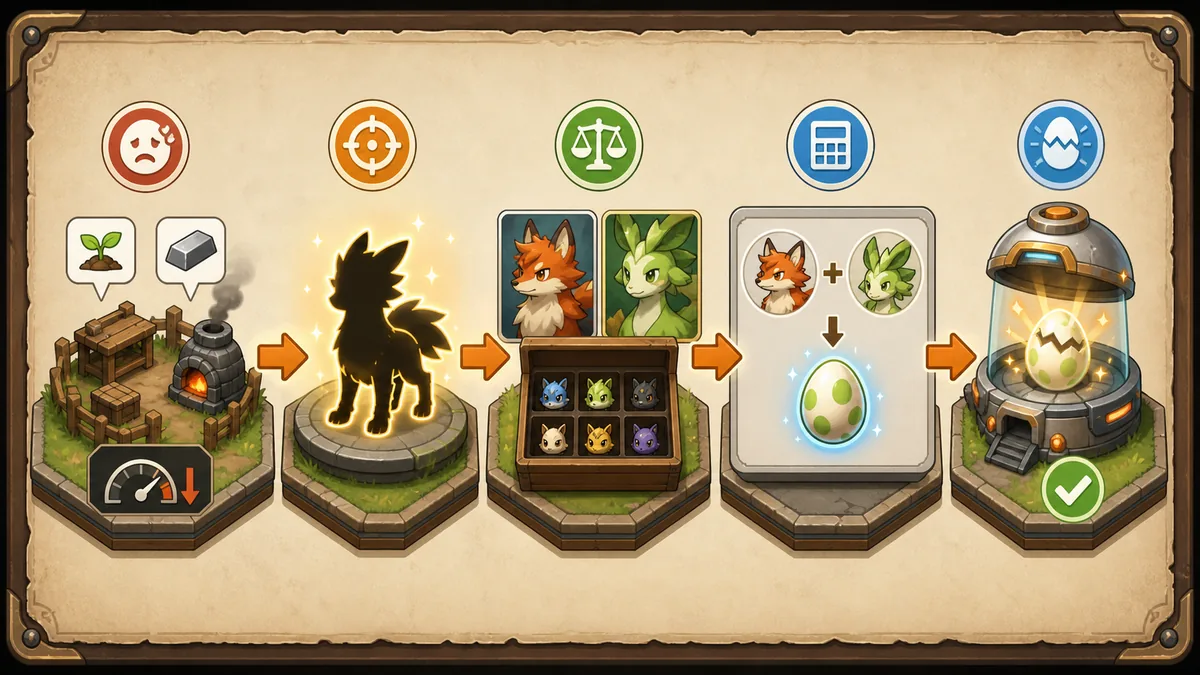
Choose the problem first, verify a pair from your own Palbox, then hatch one egg before spending a full Cake stack.
- Remove pairs that require two new captures. A valid route is inefficient when neither parent is in your Palbox.
- Inspect the parents' passives. Prefer the cleaner pool or the traits you want to carry forward.
- Confirm the exact child now. Check both parents in the current calculator before spending Cake.
- Hatch one egg after a major update. If the child differs, stop the batch and check the data status page.
PalBreed does not import or store your Palbox, so the ownership check remains yours. That one check is more useful than pretending the first pair in a table is universally easiest.
What dataset-confirmed means
PalBreed passed all 29 published pairs through the parent-to-child lookup that powers the calculator. On July 18, 2026, every pair returned the target shown above.
The active dataset is palworld-1.0.0-palcalc-v1.17.5, generated from PalCalc v1.17.5 and upstream database revision 26. The pinned manifest contains 44,851 relationships across 299 selectable records. This gives the result a traceable technical source, but it is still an unofficial fan dataset and these 29 pairs were not individually reproduced in-game.
A species match also says nothing about the final passives, IVs, gender required for a later step, or mutation outcome. Use the Palworld breeding guide for the farm and Cake workflow, and the full breeding-combinations table when you need to search the whole relationship library.
Sources and your next pair
- Palworld 1.0 official release changelog
- Mobalytics utility target shortlist
- Destructoid 1.0 target tables
- GAMES.GG 1.0 progression guide
- Palworld.tools 1.0 partner-skill reference
- PalCalc v1.17.5 source
- PalBreed data provenance
Choose the problem first, then open the Palworld 1.0 breeding calculator and compare Find Parents against the Pals already in your save. One checked egg is cheaper than finding an outdated recipe at the end of a full batch.